









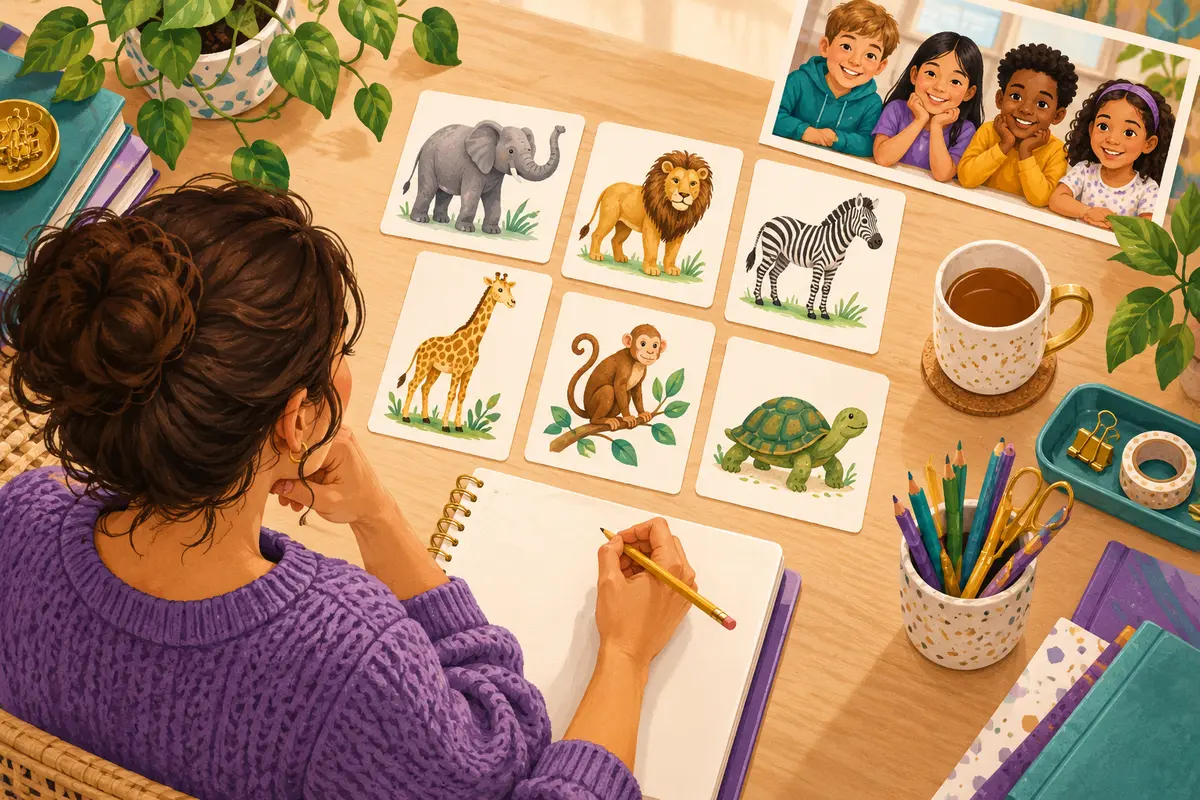

A classroom game earns its place when students practice the lesson’s language and receive useful feedback. Before choosing one, decide whether you want learners to identify a word, recall it independently or use it in a sentence. Then match the rules to that purpose.
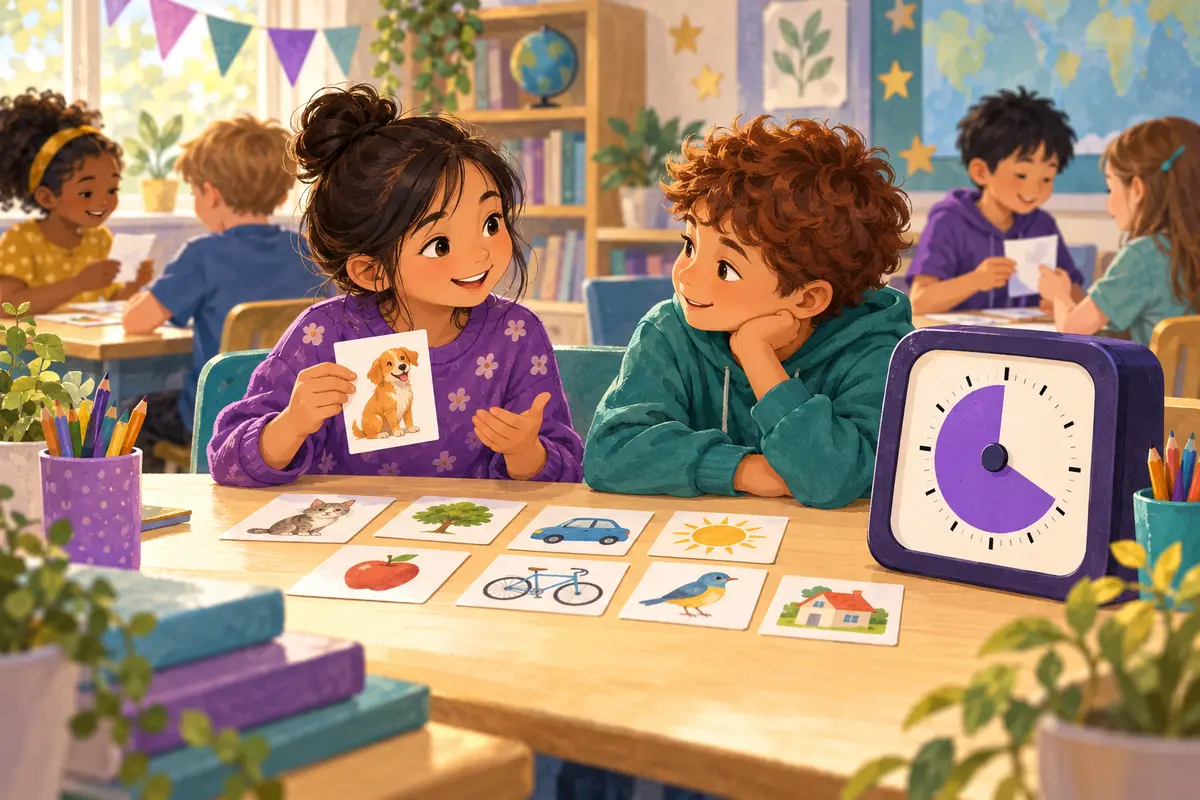
These five games use picture cards and simple classroom materials. Demonstrate one practice turn, establish how answers will be given and choose a stopping point before you begin. Each activity can run for about five minutes, with adjustments for your class.
1. Flashcard Flash
Use this for recalling familiar vocabulary. Show a card briefly, hide it and give everyone a few seconds to think. Ask pairs to agree on the word, then select a student to answer. Reveal the card and model the pronunciation if needed.
To extend the task, ask for a sentence such as “The lion is sleeping.” For beginners, show two possible pictures and let them choose. Avoid making the quickest shouted answer the only way to succeed; preparation time gives more learners a meaningful turn.
2. The Missing Picture
Display four to eight familiar cards, depending on the group. Let students study them, then ask them to look away while you remove one. When they look back, pairs name the missing item. Rotate who removes the card so students also manage the game.
Practice a useful exchange: “What’s missing?” “The bicycle is missing.” For an easier version, leave the empty space visible. For a harder round, change the card positions. Allow a quiet preview for learners who need more processing time.
3. Point to the Picture
Place cards on the board or on each pair’s desk. Say a word, a clue or a short description, and ask students to point to the matching picture. Reveal the answer together before the next turn. Desk sets let the whole class respond at once.
This is a calmer adaptation of Slap the Board. Keep learners in their own spaces and avoid running or hitting. Increase the language demand through clues such as “You wear these on your feet,” rather than increasing physical speed.
4. Classroom Charades
Choose words students can represent comfortably, such as read, swim or sleepy. Give one volunteer a card and a moment to prepare. The others ask questions using a displayed pattern: “Are you reading?” The actor confirms the answer, then another learner takes a turn.
Allow seated gestures, a partner performance or a drawing alternative. If a student prefers not to act, offer the role of questioner. For older learners, use daily routines and require a complete answer, such as “Yes, I’m reading a book.” Keep the language target visible throughout.
5. Pass and Ask
Give pairs or small circles a picture card. At your signal, the holder asks a classmate a question about it, then passes the card after the response. With a food card, students might ask “Do you like apples?” and answer “Yes, I do.” Change the card after several exchanges.
Music can mark a change of speaker, but a raised hand or visible signal works too. Provide sentence starters and let students rehearse before taking a turn. Keep everyone in the activity after an error; model the language and invite a supported retry.
Make the scoring serve the task
If you use points, state the rule before play. For example, a relevant answer earns one point, with a second point for the target sentence after support if needed. Rotate speakers and avoid deducting points for language mistakes. You can also skip scoring and work toward a shared number of successful exchanges.
Adapt one game for different levels
Keep the picture set the same while changing the response. A beginner can identify “dog,” another learner can say “It’s a dog,” and a more confident speaker can describe what it is doing. Tell students their response options in advance so the difference feels supportive and predictable.
Close with a fresh example
Stop while the activity still has a clear purpose. Show an unused picture and ask students to use the target language without the game’s clues. This brief check shows what to revisit. Classivo’s lesson images can provide prompts for review; choose the game format that gives your class enough time to speak.